Jul 24, 2026
How NETenergy and Fastway Engineering used Ansys Fluent to model micro-channel heat exchangers with phase change composite material at data center scale and uncovered a critical design insight that unlocked 35% more thermal power.

AT A GLANCE
|
|---|
ABOUT NETenergy
NETenergy is a Chicago-based thermal energy storage startup developing modular, high-performance liquid cooling systems for AI GPU data centers and battery applications. Based at mHUB Chicago, the nation’s leading hardtech and manufacturing innovation center, the company has active development partnerships with US Department of Energy Laboratories, major HVAC OEMs, and several R&D groups at leading universities nationwide.
NETenergy’s core technology combines custom-designed micro-channel heat exchangers with a proprietary phase change composite material - a system they call “Black-IceTM” - to shave peak thermal load demand. The result is a cooling architecture sized for average power demand rather than the short-duration spikes that force conventional systems to be massively overbuilt and inefficient.
THE CHALLENGE
Modern AI GPU data centers experience power demand spikes that can reach three to four, sometimes five times their average load. These spikes are short-lived, but infrastructure must be built to handle them - meaning compressors, manifolds, chillers, and cooling capacity are all sized for an extreme condition that accounts for as little as five to ten percent of actual operating time.
NETenergy identified three compounding layers of waste this creates. The first is capital expenditure: oversizing a cooling system for peak demand means every component is over-specified for conditions that occur infrequently. The second is operational energy: cooling accounts for approximately 40 percent of total data center energy consumption, and a system optimized for average rather than peak load can cut that demand by 40 to 50 percent, as NETenergy demonstrated in lab testing. The third layer is grid allocation: facilities must book peak power from the utility for those maximum spikes, and that reserved capacity sits largely unused - directly limiting how much additional compute can be deployed on the same power envelope.
A secondary challenge - which has since become one of the strongest market drivers for the technology - is resilience. During a power outage, the gap between grid failure and generator startup requires several minutes of backup cooling to prevent GPU and chip overheating. NETenergy’s thermal storage architecture carries that backup cooling capacity as an inherent property of the system, without additional infrastructure.
THE APPROACH: SIMULATION + REAL-WORLD VALIDATION
What drove NETenergy to simulation was a failed physical prototype. The first heat exchanger they built for a refrigerant-based cooling project - developed through a government-funded development program with an industrial partner - was designed to specification using standard analytical calculations. It was built, shipped, and put into test - and it did not work. Nearly all flow passed through two or three central extrusion channels while the rest of the manifold remained largely inactive. The cause: a combination of undersized extrusion geometry and a manifold pressure imbalance driven by the refrigerant entering as a gas-liquid mixture rather than the 100 percent liquid condition assumed in the calculations.
These are phenomena that standard correlations do not capture, and that experimental measurement- limited to pressure and temperature at fixed points- could not fully characterize. That experience established simulation as a non-negotiable part of the design process. For a company working across multiple cooling fluids, a wide range of thermal loads, and custom geometries for every application, iterating through physical prototypes is not commercially viable.
SIMULATION SETUP
Fastway Engineering took responsibility for the CFD workflow in Ansys Fluent, bringing simulation expertise to a problem that spans multiple physics domains: forced convection, conjugate heat transfer, two-phase flow, and the thermodynamics of a phase change composite material.
The defining challenge is scale. Where most electronics cooling work involves components measured in inches, the data center cold plates NETenergy is developing for a large-scale data center application are measured in meters. At that scale, flow non-uniformity in the manifold, including back pressure effects from fittings that are negligible in compact systems, becomes a primary design constraint. The mesh must resolve critical internal geometry at sub-millimeter precision across a structure orders of magnitude larger.
Ansys Fluent transient simulation - liquid fraction contour of the Black-Ice™ phase change composite. Blue = solid (0.00); red = fully melted (1.00).
Single-phase cases are solved in steady state with a turnaround of three to four days. Two-phase cases- particularly when coupled with conjugate heat transfer to capture the full thermal interaction between fluid, heat exchanger, and phase change composite- require transient modeling and can take up to a month per design iteration depending on fluid type and available compute.
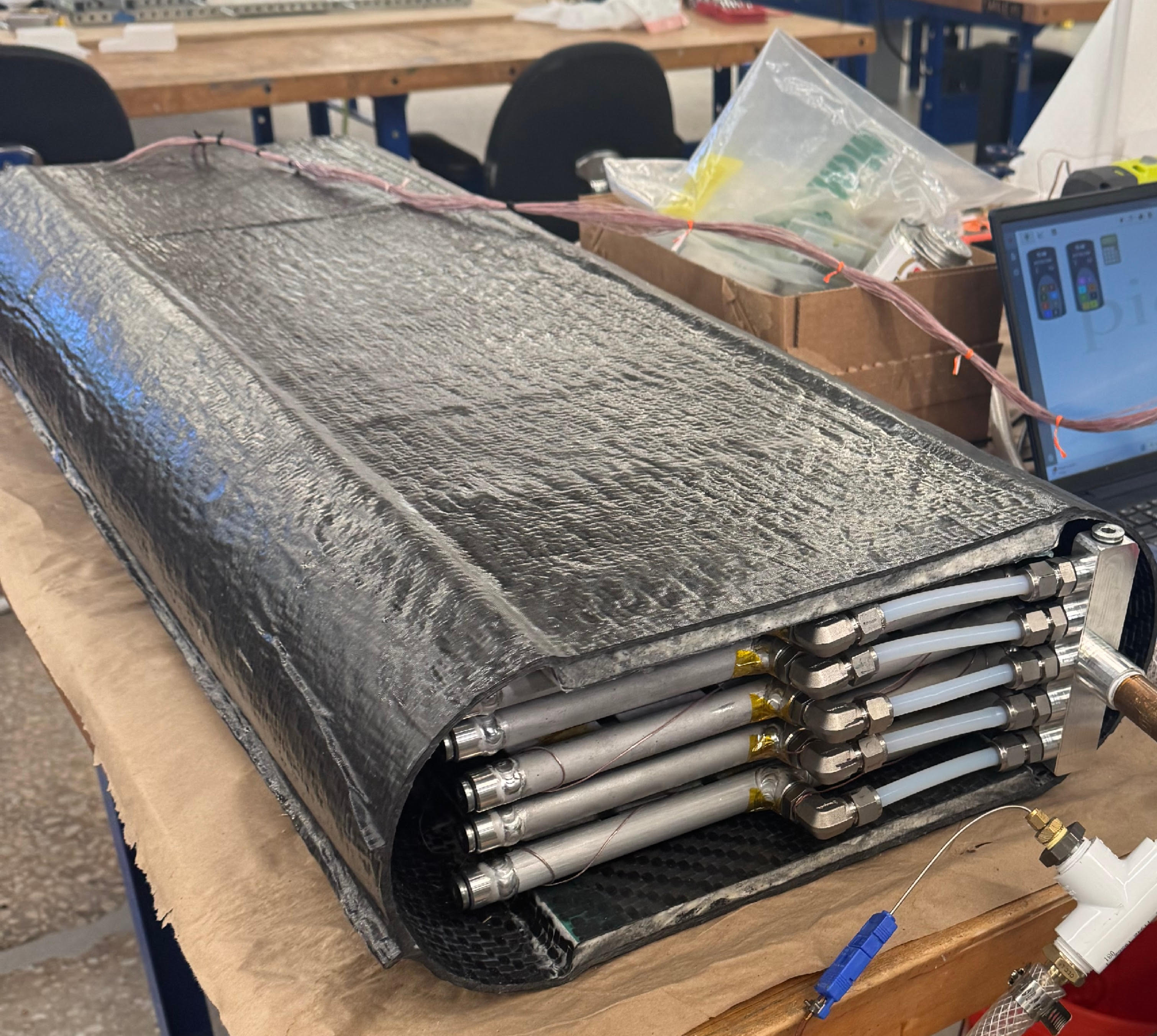
Meter-scale Black-Ice™ heat exchanger assembly at NETenergy's mHUB lab - the physical system modeled in Ansys Fluent.
RESULTS
The simulation delivered its most important finding not through a direct performance prediction, but by identifying where the design team had been looking in the wrong place. NETenergy had been iterating on material thickness, thermal conductivity, and surface area in an attempt to improve system power capacity. None of it produced the expected gains. The Ansys Fluent model identified contact resistance- the thermal interface between the “Black-IceTM” composite and the heat exchanger surface- as the limiting factor.
By quantifying the contact resistance consistently across four to five different flow rate conditions, the simulation established that mechanical interface pressure was the variable to address.
Ansys Fluent transient simulation - temperature contour across the heat exchanger cross-section, ranging from 20°C (blue) to 50°C (red).
Redesigning the interface to apply mechanical compression- integrating a carbon composite under controlled pressure rather than relying on a non-pressurized contact - delivered a thermal power capacity improvement of up to 35 percent on the same hardware.
“We decreased the thickness, increased the thermal conductivity, increased the surface area, changed the flow - we played with everything. It turned out the bottleneck was contact resistance.”
Said Al-Hallaj, CEO & Founder of NETenergy
For NETenergy, this confirmed something strategically important: that CFD modeling can reliably identify the physics bottleneck in a complex multiphysics system before a single prototype is built- directing engineering effort toward the variables that actually matter.
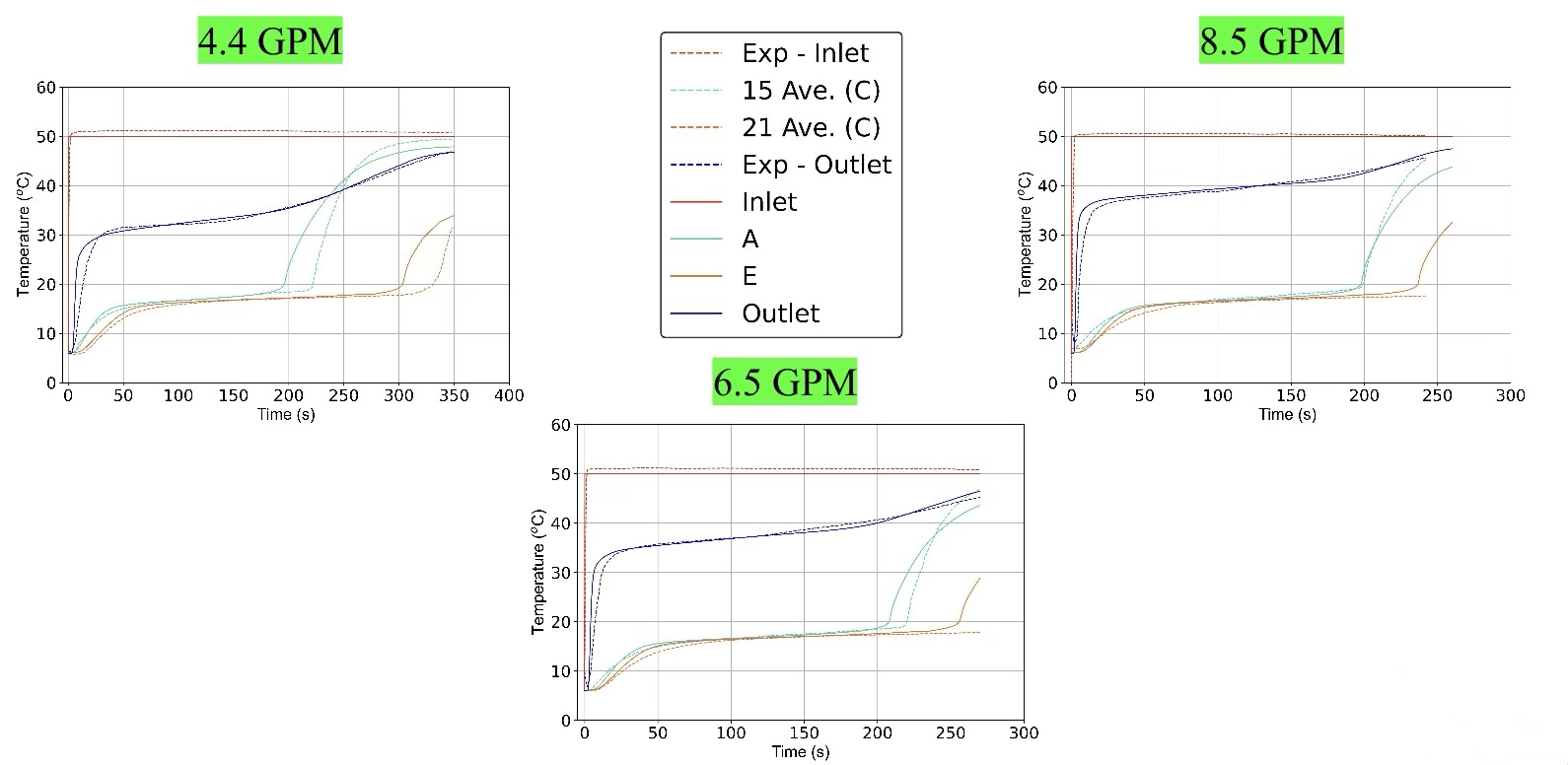
CFD x Experiment Results
ENABLING FACTORS
Three capabilities had to come together for this project to succeed:
Ansys Fluent: The solver’s transient multiphase capability, conjugate heat transfer modeling, and meshing tools were essential to capturing the physics across the full complexity of the system- from micro-channel geometry to phase change material behavior to two-phase refrigerant flow.
Fastway Engineering’s Multiphase CFD Expertise: Simulation expertise was the connective tissue of the project. Modeling a large-format heat exchanger with anisotropic phase change composite, two-phase refrigerant flow, and thermal contact physics requires hands-on CFD experience that goes well beyond standard software operation. Fastway’s role was to make the hard parts tractable.
NETenergy’s experimental program: The simulation work is being run in parallel with a purpose-built thermal conductivity measurement device developed in-house by the NETenergy team - because no commercially available instrument matched their material requirements. The value of the CFD work is sharpened by the ability to validate findings against physical measurement.
LOOKING AHEAD
The simulation work is ongoing. Ahmad Ijaz, CFD Engineer at NETenergy and PhD candidate in Chemical Engineering at Illinois Institute of Technology, is completing the two-phase refrigerant modeling and preparing the first peer-reviewed publication on CFD modeling of this system, benchmarking the Ansys Fluent model against a published case from the literature as a first validation step before applying it to NETenergy's own geometry. In parallel, the team has built a custom thermal conductivity measurement device in-house - necessary because no commercially available instrument matched the material requirements of the “Black-IceTM” composite - which will quantify the contact resistance directly and cross-confirm what the CFD model identified.
On the product side, the validated simulation foundation gives NETenergy a repeatable design tool for a product line that spans multiple cooling fluids, load profiles, and physical form factors. Each new customer application - whether glycol, water, CO₂, or R410 refrigerant; whether rack-top or rack-side; whether low or high heat flux - can be evaluated in simulation before anything is fabricated.
ABOUT THE PARTNERS
Fastway Engineering is a Chicago-based Ansys partner specializing in simulation software, services, and training. Fastway bridges academia and industry by deploying predictive engineering workflows across structures, fluids, electronics, HPC, and optics - helping product development teams solve complex design problems faster.
NETenergy is a thermal energy storage company based at mHUB Chicago. Their solutions are developed for data centers and building owners, helping them reduce peak demand and improve energy efficiency through integrated thermal storage.
Your engineering challenge could be our next case study.