Apr 14, 2026

Reactor systems are central to a wide array of regulated industries, including petrochemicals, pharmaceuticals, advanced materials manufacturing, biofuels, and sustainable energy production.Their design is traditionally governed by strict specifications, safety codes, and conservative engineering rules intended to ensure compliance and reliability.
Yet even within these tightly controlled frameworks, significant opportunity exists to improve performance, reduce cost, and enable next-generation technologies.
Modern reactor modeling approaches using Computational Fluid Dynamics (CFD) and Finite Element Analysis (FEA), commonly applied across industrial simulation projects at Fastway Engineering, allow engineers to move beyond simplified assumptions and directly simulate real operating conditions. By capturing complex thermal behavior, flow dynamics, pressure loading, and structural response, simulation enables optimized reactor design focused on thermal uniformity, higher process throughput, improved reliability, and lower total cost of ownership.
This shift is increasingly critical as industries pursue lower carbon intensity (CI - the total greenhouse gas emissions per unit of product), tighter efficiency targets, and innovative reactor configurations in areas such as sustainable aviation fuels, advanced bioreactors, and next-generation chemical processing.
Why Cooling System Design Determines Reactor Performance
A reactor’s throughput and efficiency are fundamentally constrained by its ability to manage heat. Reaction kinetics, catalyst stability, material durability, and safety margins are all directly influenced by temperature distribution within the vessel.
Traditional reactor design often relies on empirical correlations and simplified heat transfer equations to size cooling jackets, shell and tube reactor systems, or internal heat exchange components. While useful for preliminary design, these approaches cannot accurately represent the complex physics occurring inside operating reactors.
Within real systems, internal gas velocities, turbulence structures, pressure fluctuations, and localized recirculation zones drive highly non-uniform thermal behavior. These effects occur in confined spaces where direct measurement is difficult and where physical prototyping and iteration are economically impractical.
CFD simulation of oxygen mixing within a stirred bioreactor vessel, illustrating flow-driven mass transfer and non-uniform concentration zones that directly influence process efficiency.
CFD-based reactor modeling provides detailed visibility into these hidden flow and thermal phenomena. Engineers can directly evaluate how cooling system geometry, flow rates, and operating conditions influence temperature uniformity and process efficiency.
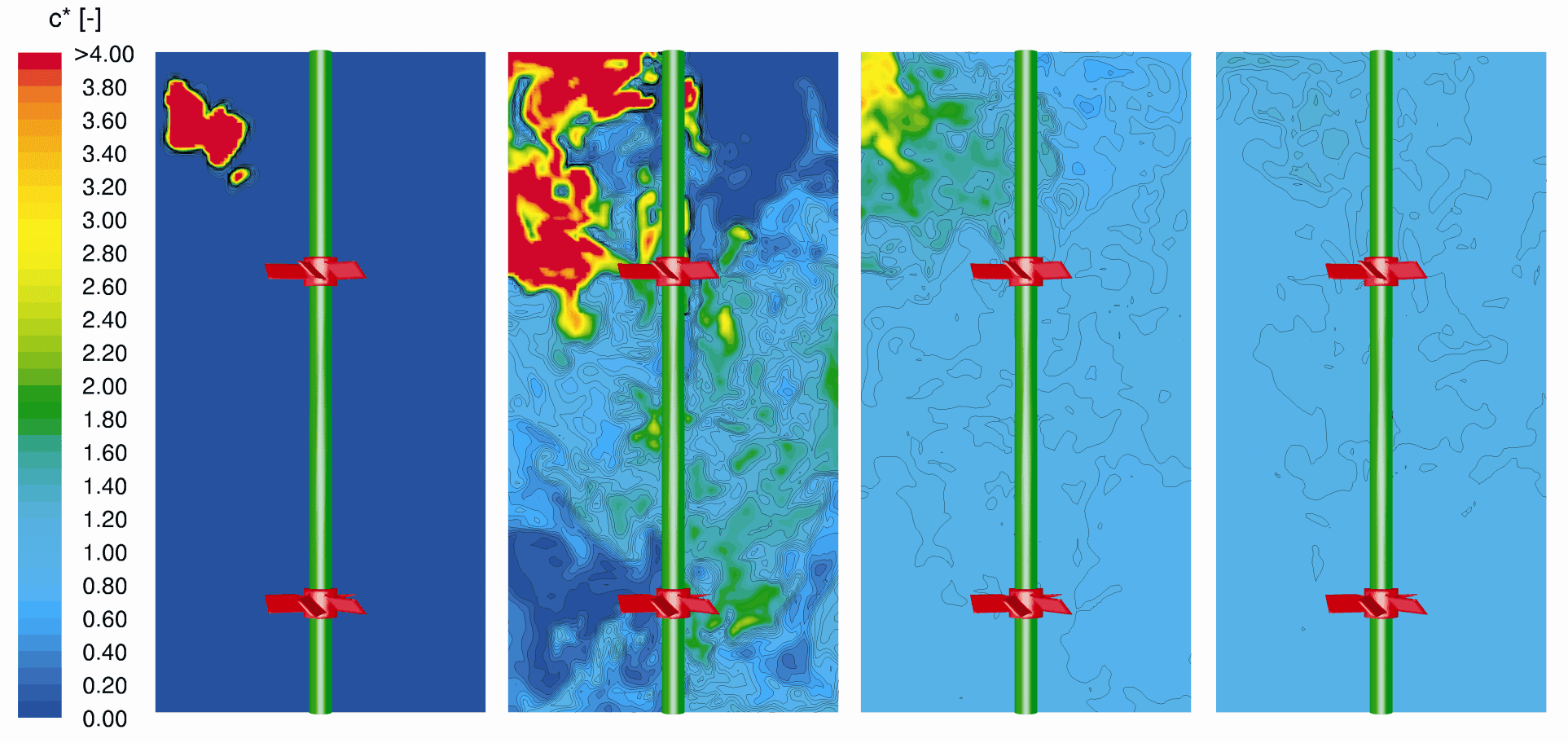
Tracer-based CFD visualization showing species dispersion within the reactor volume, revealing mixing efficiency and residence time behavior critical to thermal and reaction uniformity.
This capability is especially valuable in applications such as bioreactor design, where even small temperature deviations can significantly impact yield and productivity. Advanced simulation approaches have already demonstrated how optimized flow and heat transfer can substantially improve reactor efficiency in biologically driven systems - as shown in Ansys’ work on maximizing bioreactor efficiency with simulation.
By using CFD to design reactors and their cooling systems together as an integrated thermal system, engineers can safely increase throughput while reducing hot spots, material degradation, and energy waste.
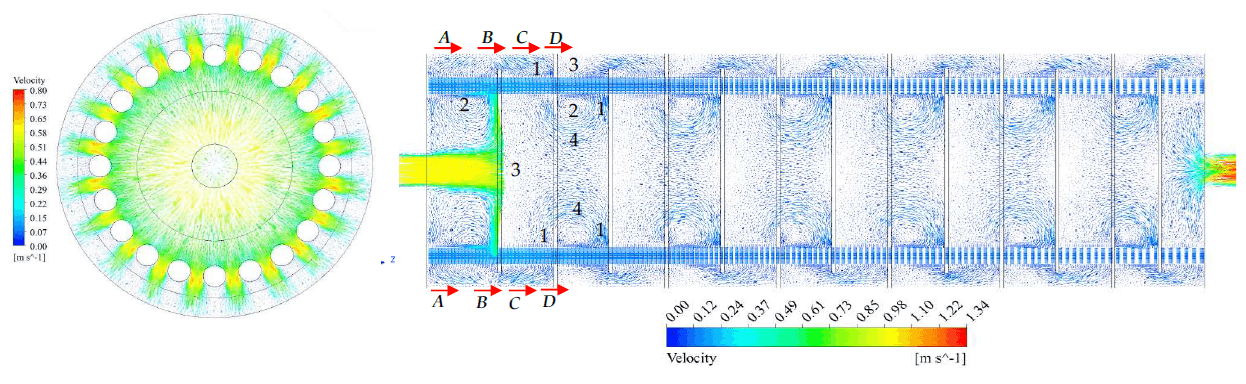
Validated CFD reactor model correlating heat transfer, mass fraction, and flow patterns with experimental data, demonstrating predictive accuracy for performance-driven reactor design. Image courtesy of Victor Soto, Claudia Ulloa and Ximena Garcia
Reducing Cost and Improving Reliability with Design by Analysis
While thermal performance drives productivity, mechanical integrity governs safety, lifecycle cost, and regulatory compliance. Pressure vessel design and reactor mechanical systems are traditionally developed using conservative formula-based approaches derived from industry standards.
These “design by rule” methods - based on simplified linear equations and conservative safety factors - ensure safety through simplified linear equations and high safety factors, but they rarely reflect the true operating environment of modern reactors.
In reality, reactor structures experience a complex combination of cyclical thermal stresses, variable internal pressures, flow-induced vibration, and dynamic environmental loads such as seismic activity. When thermal non-uniformity is present, localized stress concentrations often far exceed what simplified equations predict.
As a result, many reactor systems and cooling structures are overdesigned, leading to excessive material thickness, higher fabrication cost, and reduced thermal efficiency.
FEA-based pressure vessel design enables a more accurate “design by analysis” approach. By directly importing temperature and pressure fields generated through CFD, engineers can compute true operating stresses across the reactor shell, welded joints, supports, and cooling components.
This integrated CFD-FEA workflow allows optimization of material thickness, improved welded joint reliability, and realistic fatigue life assessment - all while maintaining compliance with pressure vessel design requirements such as BPVC Section VIII Division 2 Part 5 (design by analysis methods for pressure vessels)
Rather than relying on overly conservative assumptions, engineers can design reactors that are both safer and more cost-efficient, with improved reliability over the full operating lifecycle.
Driving Advanced and Sustainable Reactor Technologies
As industries transition toward cleaner energy and advanced manufacturing, traditional reactor design approaches are being pushed to their limits.
Applications such as sustainable aviation fuels, biofuels, and advanced gasification systems with fixed-bed and fluidized-bed reactor configurations introduce new thermal regimes, multiphase flow behavior (simultaneous interaction of gases, liquids, and solids), and mechanical demands that cannot be adequately addressed using simplified design tools alone.
Modern bioreactor systems, novel shell and tube reactor configurations, and innovative chemical conversion technologies increasingly rely on precise thermal control and optimized flow environments to achieve commercial viability.
At the same time, regulatory pressures focused on emissions reduction and carbon intensity are driving the need for higher efficiency, lower energy consumption, and improved process reliability.
In this evolving landscape, physics-based simulation becomes the foundation for advanced engineering methodologies - including parametric optimization (systematically varying design parameters), generative topology (algorithm-driven structural design), machine learning, and AI-driven design exploration
CFD and FEA are the stepping stones that enable these next-generation tools. They provide the accurate physical understanding required to safely explore new reactor geometries, cooling strategies, and material configurations while maintaining compliance with regulatory frameworks.
This leads not merely to incremental performance gains, but empowers the development of disruptive reactor technologies essential for fostering sustainability, reducing costs, and ensuring long-term competitiveness.
Focusing on Peak Operational Performance
Simulation provides a higher degree of engineering precision, even for designs rigorously controlled by industry standards and specifications.
Through integrated reactor modeling, engineers can optimize thermal uniformity to increase throughput, reduce material usage while improving structural reliability, lower both fabrication and operating costs, extend equipment lifespan, support carbon intensity reduction initiatives, and enable innovative reactor architectures that would be difficult to achieve using traditional design approaches alone.
CFD and FEA do not replace regulatory requirements, but strengthen them by revealing true operating behavior and eliminating unnecessary conservatism.
By shifting from assumption-driven design to physics-based engineering, organizations can achieve safer, more efficient, and more sustainable reactor systems.
Using Simulation to Optimize Reactor Design
Modern reactor design demands more than simplified equations and conservative margins. It requires accurate understanding of flow behavior, heat transfer, structural response, and their combined impact on performance, reliability, and cost.
Simulation-driven approaches using CFD and FEA provide the tools to design optimized cooling systems, realistic pressure vessel structures, and next-generation reactor technologies - even within the strictest regulatory environments.
As industries pursue higher throughput, lower carbon intensity, and innovative energy and materials solutions, physics-based reactor modeling will continue to be a cornerstone of competitive engineering.
You may also find value in Fastway’s work across CFD-driven thermal design, structural analysis, and multiphysics workflows:
https://www.fastwayengineering.com/applications/ansys-fluent
https://www.fastwayengineering.com/applications/ansys-mechanical